
 Harry's Peloponnese Guide:
 Though winters are harsh, summers are pleasantly cool, due to its altitude, but there are also thunderstorms and even hail. Vines, wheat,and barley are grown but the plateau is nearly treeless except for the mulberry trees.
There are some marshes but few streams, and the ones that exists disappear into holes in the ground known as 'katovothrae'.
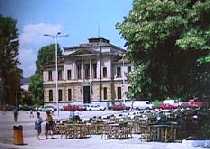 The modern town is the only big town of Arcadia, and chief communication center for the Peloponnese. With a
population of around 30,000, Tripoli is a modern manufacturing town, with hollow-ware and carpet factories, tanneries,
and wine production.
The modern town is the only big town of Arcadia, and chief communication center for the Peloponnese. With a
population of around 30,000, Tripoli is a modern manufacturing town, with hollow-ware and carpet factories, tanneries,
and wine production.
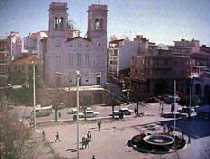
It is home to one of the biggest army barracks in Greece and an Air Force base as well, the two at opposite ends of the city, though some find Tripoli a pleasant town with small parks, outdoor cafes, some of them on the three nice squares in the town.
There are also some old harness and saddlery shops and some traditional side streets with cafes. One can find exceptional yogurt here, at Kanatas on the side street behind the Aghios Vasilis church near the center of town.
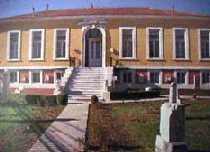 The spectacular mountains on the periphery of the town is also one of its nice features. Cultural activities include
books fairs and stage productions in its neo-classical 19th century theater, and has several outdoor cinemas near the
Platia Areos.
The spectacular mountains on the periphery of the town is also one of its nice features. Cultural activities include
books fairs and stage productions in its neo-classical 19th century theater, and has several outdoor cinemas near the
Platia Areos.
The Panarcadic Archeological Museum at Evangelistras 6, is worth visiting (open Tues-Sun 8:30am-3pm;2euros admission), with a collection of finds from Arcadia dating from Neolithic to Roman times. The museum has a lovely rose garden.
 The three ancient cities of the plain had become derelict when Tripoli was founded in the 14th century, hence
subsuming them.
The three ancient cities of the plain had become derelict when Tripoli was founded in the 14th century, hence
subsuming them.
It was called Droboglitza or Hydropolitza by the Greeks, and later Tripolitza. The Turks called it Tarabolussa and in 1770 it became the fortified capital of the Pasha of the Morea ('Morea' being the old Greek name for the Peloponnese, and meaning 'mulberry tree').
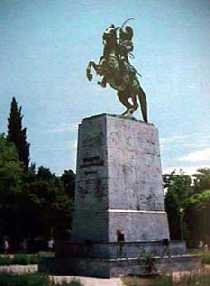
During the first year of the Greek War of Independence, it was taken by Kolokotronis, who had the the local Turkish population massacred; in 1824 Ibrahim Pasha retook the town and destroyed it in the retreat of 1828. After 1834, it was restored. Also see: Mantineia | Tegea | Megalopoli

Why not enjoy Harry's Free Musical Compositions while you read this site? (opens seperately)
©Harry's Greece Travel Guides